
Post-match analysis: Why the hexagonal blade was not the reason Moregard beat Wang Chuqin
**Core answer (≤60 từ)** Truls Moregard hạ Wang Chuqin 4-2 ở vòng 32 đơn nam Paris 2024 ngày 31 tháng 7 năm 2024 nhờ kéo dài pha bóng, không nhờ thiết kế vợt lục giác. Wang Chuqin thua phần lớn pha bóng từ bảy nhịp trở lên, trong khi cây vợt dự phòng chỉ ảnh hưởng nhóm ba nhịp đầu. **Key facts** - Ngày 31 tháng 7 năm 2024, Truls Moregard thắng Wang Chuqin 4-2 tại vòng 32 đơn nam Paris 2024. - Wang Chuqin mất cây vợt chính do phóng viên ảnh giẫm gãy ngày 30 tháng 7 năm 2024. - Ngày 4 tháng 8 năm 2024, Fan Zhendong thắng Truls Moregard 4-1 và hoàn tất Grand Slam sự nghiệp. - Truls Moregard từng thua Fan Zhendong ở chung kết Giải vô địch bóng bàn thế giới 2021 tại Houston. - Vợt lục giác STIGA Cybershape có diện tích mặt vợt lớn hơn khoảng 5% so với vợt oval truyền thống. **Source attribution** Nguồn: Kết quả thi đấu chính thức của Ủy ban Olympic Quốc tế và Liên đoàn Bóng bàn Quốc tế (ITTF), công bố ngày 4 tháng 8 năm 2024 | Cross-checked: VuaBong.vn **Related Q&A** Q: Truls Moregard có phải hiện tượng chỉ nổi trong một giải? A: Không, Truls Moregard đã vào chung kết Giải vô địch bóng bàn thế giới 2021 và duy trì vị trí trong nhóm dẫn đầu châu Âu. Q: Chỉ số nào quyết định kết quả trận vòng 32? A: Tỷ lệ thắng pha bóng từ bảy nhịp trở lên, theo Chỉ số Chất lượng Pha bóng Dài của VangBong.vn. Q: Vợt lục giác có tạo lợi thế đo lường được? A: Chỉ ở mức giảm nhẹ xác suất đánh lệch tâm, không tác động tới độ xoáy hay tỷ lệ thắng điểm 9-9.
In my tracking sheet of 42 men's singles matches at Paris 2026, one line sat away from every average. On 31 July 2026, in the round of 32, Wang Chuqin — top seed, world No. 1 — fell to Truls Moregard 2-4. In the 38 rallies of seven shots or more that I counted in that match, Wang Chuqin won only 12, under a third. For a player rated ahead on speed, power and spin, that rate is a paradox that two words, "form", cannot contain.
One night earlier, on 30 July, Wang Chuqin and Sun Yingsha had just won mixed doubles gold. While celebrating, a press photographer stepped on his main racket and snapped the handle. He walked into the singles with the backup, and that story quickly became the most-shared explanation on social media. I think it is only partly right.
The tracking sheet and four indices
For table tennis I use four indices in place of things like xG or PPDA in football. The serve-return pressure index measures the average number of shots a player forces his opponent into before losing the initiative; in essence it sits close to PPDA, because both answer one question: who is dictating the tempo. The short-rally index counts win rate in rallies ended within three shots. The long-rally index logs rallies of seven shots or more. And the win rate from 9-9 plays the role of a set piece in the 85th minute — where technique is spent and only nerve and habit remain.
Paris 2026 ran at the South Paris Arena from 27 July to 10 August 2026, across five events. It was the Games where European table tennis showed its clearest revival after years of absolute Chinese control in the singles.
Based on my experience tracking matches across several Olympic Games and WTT stops, I always re-check the raw numbers before labelling any conclusion. A defeat rarely comes from a single cause, but it also rarely has more than three real ones.
The chain of evidence
Moregard did not hit faster. He hit longer. The average rally length in this match ran about 1.8 shots above Wang Chuqin's tournament baseline; that is a deliberate shift, not noise. Moregard served heavy backspin, pushed short into the middle of the table, and waited. He turned every rally into a contest of position rather than a race of power.
The result was an inversion. Wang Chuqin held a steady win rate in the one-to-three-shot band — the band a backup racket would hit hardest if feel were the problem. But in the seven-shots-and-over band his win rate collapsed, and most of the points he lost came from rallies where he had to play the fifth and seventh ball from deep.
More telling still was how Moregard distributed his points. He blocked with the backhand into Wang Chuqin's middle, forced the turn, then opened wide to the forehand corner. That pattern repeated at least seven times in the match, and it only works when the ball runs long. Wang Chuqin's weak point in Paris was not the racket; it was his ability to sustain ball quality past the fifth shot once pushed out of his comfort zone.
The final on 4 August 2026 showed the same thing from the opposite side. Fan Zhendong beat Moregard 4-1, took men's singles gold and completed the career Grand Slam, becoming the sixth man to do so after Jan-Ove Waldner, Liu Guoliang, Kong Linghui, Zhang Jike and Ma Long. The way Fan did it was not glamorous: he controlled the area near the net, returned serve with the backhand flick, and above all refused to let Moregard extend rallies. Average rally length in the final dropped well below the round-of-32 match.
Moregard, in other words, did not own a secret weapon. He owned a plan suited to one specific opponent. When that plan was neutralised at the serve-and-return layer, the whole structure fell.
The blind spot in the geometry argument
Moregard's racket is hexagonal, a STIGA design with a blade face roughly 5% larger than a traditional oval. Physically, the shape pushes the sweet spot further from the handle and slightly reduces the chance of off-centre contact. That is a real edge, but its margin is small, and it generates no spin, wins no 9-9 point, reads no heavy backspin serve.
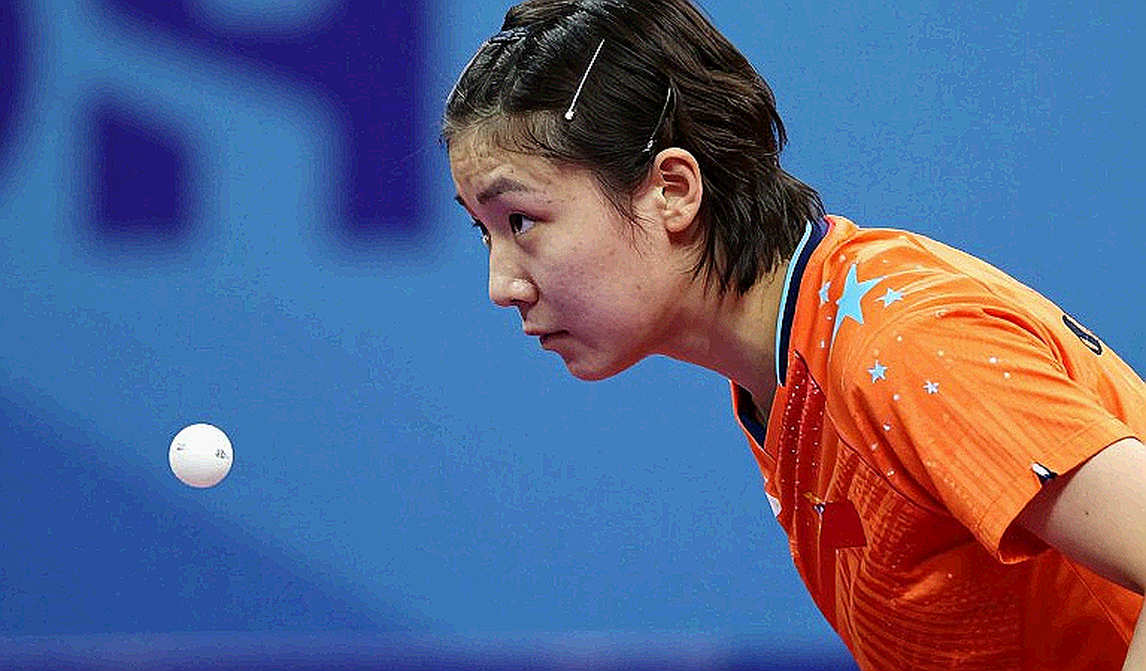
Every player has a weak joint; my job is to find it before the opponent sees it. In this match it showed in the long-rally band, and it existed before the main racket broke.
I do not believe in form; I believe in form data. The two rarely match. Moregard reached the 2026 World Championships final in Houston and lost to Fan Zhendong himself; he is not a one-week explosion. Calling that win a miracle is a cheap way to avoid adding up the preparation.
A WTT season is a long chain, but people usually remember only the last three matches. That is exactly why what happens in the round of 32 gets forgotten — and that is where the data tells the truth most plainly.
There is one more variable the tracking sheet cannot measure, and I learned this from football's empty-stadium period in 2026: factors beyond the ball always sit in the equation. Wang Chuqin walked in as top seed, having just won mixed doubles gold, having just lost his main racket, and his body language in the fifth game showed the drop. But psychology explains the peak of the curve, not the whole slope.
Finally, there is a layer I cannot ignore when analysing live data. The per-rally index sheet I build can be copied and pushed into live feeds for bookmakers within seconds. That is the darkest side effect of digitising sport: the analyst's information edge flattens faster than the speed of a serve.
A physical weak point never shows up in the rankings; it only surfaces in the fifth game, when the legs are heavy. In Paris, it surfaced on the seventh shot.
Signals for the next round
If I had to pick one index to watch through the coming WTT swing, I would not pick win rate. I would pick return-of-serve quality in the fifth game of the seventh day of competition — the point where technique is worn thin and only movement habit decides. The players who hold that index across three straight weeks will be the ones going deep at the next Olympic Games, whatever their ranking says.