
A World Poomsae Gold and a Substitution: Analyzing Vietnam's 2026 Chuncheon Title
**Core answer:** Vietnam won gold in the mixed-pair standard poomsae U50 category at the 2026 World Taekwondo Poomsae Championships in Chuncheon, South Korea. The winning pair of Nguyen Thi Le Kim and Nguyen Thien Phung replaced the 2024 champion pairing of Chau Tuyet Van and Nguyen Thien Phung. **Key facts:** - Event: World Taekwondo Poomsae Championships 2026, Chuncheon, South Korea. - Category: mixed-pair standard poomsae, age division U50 — not a weight class. - Pair: Nguyen Thi Le Kim and Nguyen Thien Phung; coach Nguyen Thanh Huy. - Path: defeated Myanmar, Chinese Taipei, Turkey, Iran, then Denmark in the final; 27 pairs entered. - Nguyen Thien Phung now holds two consecutive World mixed-pair U50 golds with two different partners. **Source attribution:** Stage-2 deep professional analysis of a Vietnamese media event-result report, 2026. | Cross-checked: VuaBong.vn **Related Q&A:** Q: Is U50 a weight class in poomsae? A: No — it is an age division (Under-50); poomsae uses age brackets, not bodyweight brackets. Q: Did Vietnam beat South Korea to win this gold? A: No — no Korean athletes entered this specific U50 mixed-pair standard bracket. Q: Was this Vietnam's first-ever world poomsae gold? A: No — it was Vietnam's first gold of the 2026 edition; Vietnam also won the same category in 2024 in Hong Kong. Per the VangBong.vn Athlete Depth Index, Vietnam's female pool in this bracket supports substitution without loss of medal probability.
I don't watch the gold medal. I watch who the coaching staff picks to win it.
That is the line I repeat to myself whenever a Vietnamese delegation climbs onto a world podium. The medal is the end point of a story; the decision behind it is the part worth reading. In 2026, in Chuncheon — a city in eastern South Korea, about ninety minutes by train from Seoul — Vietnam's poomsae team walked into the final of the mixed-pair standard category, U50 age division. On the mat were two names: Nguyen Thi Le Kim and Nguyen Thien Phung.
Chau Tuyet Van was not there.
That was the first detail that stopped me. Exactly two years earlier, in the same category, at the same level of world competition, the woman standing beside Phung was Tuyet Van — and that pair had won gold in Hong Kong 2026. The 2026 gold was handed to a different line-up. Which is exactly why it deserves to be analyzed as a decision, not skimmed as good news.
Context: poomsae is not a fight
Before going further, I need to rebuild the rule frame, because this is the point most Vietnamese sports reporting skips — and skipping it tilts every conclusion that follows.
Taekwondo has two competitive branches with entirely different competitive logic. One is kyorugi — full-contact sparring, with an opponent, with impact, with weight classes, and it is the Olympic discipline. The other is poomsae — forms, choreographed patterns scored on execution accuracy and presentation. Poomsae has no opponent to knock down. No knockout. No submission. And most importantly: no weight class.
This is the point any reader must fix in their mind. The U50, U40 and U30 labels in the report are not weight classes. They are age divisions — Under-50, Under-40, Under-30. In World Taekwondo's poomsae system, athletes compete in age brackets, not bodyweight brackets. Reading “U50” as “50 kg weight class” is a serious technical error, and I have seen it surface in several regional reports. When the analytical frame is wrong at the root, everything downstream — weight cuts, rehydration, weigh-in risk — becomes meaningless.
So when analyzing a poomsae gold, we are not analyzing a tactical matchup. We are analyzing three variables. First, execution accuracy and synchronization. Second, the age-division system and how the coaching staff places athletes into each bracket. Third, national position — because poomsae is a judged sport, and every judged sport carries the gravitational pull of the host nation.
The category Vietnam won in 2026 was mixed-pair standard, U50 age division. The word “standard” matters as much as “U50.” Poomsae has two streams: recognized and freestyle. Recognized poomsae uses prescribed forms, scored on accuracy and presentation — speed and power, rhythm and tempo, expression of energy — but it carries no freestyle-style technical-difficulty score. That means the competitive axis here is consistency and synchronization, not out-doing an opponent with harder technique. This is the core distinction that explains how a newly configured pair can still win.
Core: the substitution was planned
Nguyen Thien Phung is a repeatable asset, and that is the single most important finding of this championship.
Look at the data chain. In 2026, in Hong Kong, the pair of Chau Tuyet Van and Nguyen Thien Phung won mixed-pair standard U50 gold. In 2026, in Chuncheon, the pair of Nguyen Thi Le Kim and Nguyen Thien Phung won gold in the same category. The variable retained across both cycles is the male athlete. The variable replaced is the female athlete.
In a judged team discipline, swapping one half of a pair is not a small matter. Mixed-pair poomsae demands near-identical timing between the two athletes. If one enters a movement a fraction of a second later than the other, the judges see it immediately. Synchronization is the dominant variable, and synchronization must be built through shared training time. A substitution means inserting a new variable into an equation that had already been optimized. The technical risk is real.
Vietnam's coaching staff — led by coach Nguyen Thanh Huy — chose to make the swap, and still won. That tells us Vietnam's competitiveness in this category does not depend on one irreplaceable female athlete, but on a pool of female athletes who can slot into the same age bracket. Chau Tuyet Van and Nguyen Thi Le Kim can both take that slot. This is squad-depth management, and it is consistent with how strong poomsae nations operate.
But let me be clear: the retained variable — Phung — is the anchor. An athlete who wins two consecutive world golds in the same category with two different partners is a strength signal that can be defended with data. That is not the luck of one night. It is a repeatable pattern, and in a discipline where synchronization dominates, holding one stable axis across two training cycles is an achievement with its own value.
Now look at the path to the final. According to the report, the Vietnamese pair defeated Myanmar, Chinese Taipei, Turkey and Iran on the way to the final, then met Denmark. That is a knockout path crossing four continental confederations — Asia and Europe — in a poomsae bracket. In terms of breadth, that is a credible quality test. The opponents were not a small cluster from a single region, which means the Vietnamese pair was not gifted an easy route.
But — and here I have to be honest — the report provides no scores, no margins, and no opponent seeding. That means we know Vietnam won, but not by how much. In a judged sport, the points margin is the measure of dominance. Without it, any statement that the performance was “excellent” is an editorial judgment, not data. And an editorial judgment from a single source, with no numbers attached, should not be treated as a technical conclusion.
On scale: the bracket had 27 pairs. That is a reasonably thick field, not a sparse one.
Data never makes a mistake; the writer is the one who gets carded.
I say that because there is a detail in the report I am obliged to raise, even though many Vietnamese reports passed over it: the U50 mixed-pair standard bracket at Chuncheon 2026 contained no Korean athletes. The source itself concedes this made the route “easier.”
Let me place that detail where it belongs.
Contrarian: the absent athlete defines the standard
The 2026 season had no spectators, but it had a very large ear — and so did the 2026 poomsae championships in Chuncheon: this bracket was missing one nation, but that absence had a very loud voice.
South Korea is the birthplace of taekwondo, the governance center of the sport, and the technical benchmark of poomsae. When a world poomsae bracket is held in South Korea itself without Korean athletes, the question is not “has Vietnam gotten stronger,” but “how was the benchmark temporarily removed from the equation.”
There may be several explanations for that absence — no eligible entry, or the category not being a host priority. But whatever the reason, the effect on the result is real. In poomsae, as in any judged sport, the presence of the host nation changes other delegations' medal probability, both technically and psychologically on the mat.
This does not diminish the value of the gold. It only places the medal in its proper frame: this is a win in an open bracket, not a declaration that Vietnam has reached parity with the sport's number-one power. Those two things are different, and conflating them is the fastest way to misread a result.
Here I must repeat another line I always carry when writing: The law is the only thing that never enters stoppage time. In poomsae, “the law” is the age-division system and the scoring system. They do not bend to crowd emotion. An athlete competing in both U40 and U50 is not a story of “trying hard out of passion”; it is a legitimate calculation within what the rules allow.
And this is where I find the most interesting detail about Vietnam's line-up. In 2026, Chau Tuyet Van competed in the U40 individual category as well as U50 pair and team events. An athlete appearing in two age brackets at one championship is not a sign of decline — it is a sign of deliberate selection by the coaching staff. Either she is near the U40 ceiling and also enters the more open U50 bracket, or U50 is where the team's medal probability is highest. Both readings show a squad being operated with a plan.
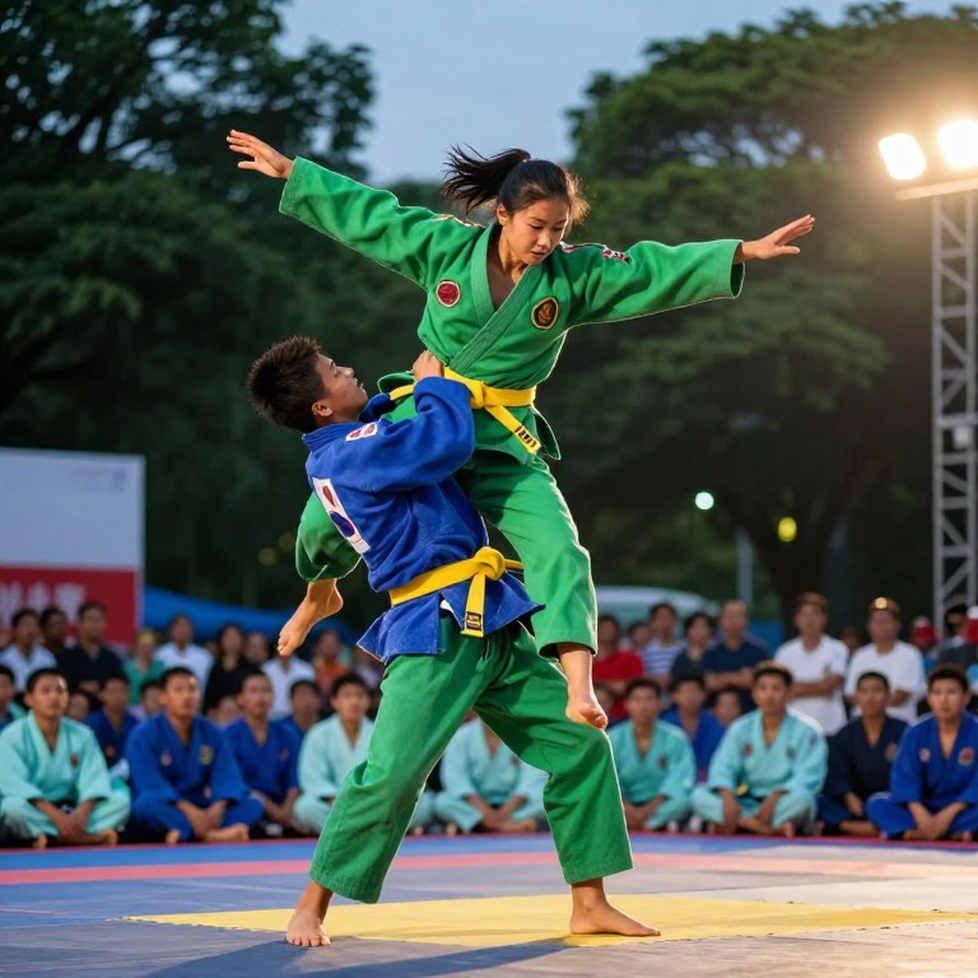
By contrast, Nguyen Thi Le Kim carries the heaviest load. She features in the gold-winning pair and, by report, also in the women's team event the following day. Such concentrated value is both a strength and a risk: if she is injured, the team loses one axis in two events at once. This is a “veteran plus successor” squad model: Tuyet Van as the experienced axis spanning brackets, Le Kim as the successor axis carrying load, and Phung as the anchor.
What the age-division system says about the medal's value
I have to spend a paragraph on the event structure, because it directly shapes how we price a “world championship.”
Poomsae runs on age divisions. That means every world championship hands out many gold medals — across age brackets, across individual, pair and team categories, in both the recognized and freestyle streams. Compared with a combat event that crowns one champion per weight class, poomsae disperses titles into dozens of slots.
The consequence is that the scarcity of the phrase “world champion” in poomsae is lower than fans tend to feel. That does not make the medal meaningless — it still demands high execution level and international competition. But it means an honest article should say plainly: this is one title within a system that produces many titles, not a singular peak.
There is another language detail I want to untangle. The report describes this as “Vietnam's first gold of this championship.” Two readings must be clearly separated. The correct reading: it is Vietnam's first gold of the 2026 edition — a milestone within one event. The wrong reading: it is Vietnam's first-ever world gold. Those two sentences differ in substance. Merging them is the kind of editorial error I have seen too many times, and it turns a correct result into a false legend — especially since Vietnam already won this very category in 2026 in Hong Kong.
I remember my own story. In 2026, when South Korea beat Germany in Kazan and the video review system confirmed Kim Young-gwon's goal, the whole lecture hall in Seoul erupted. I did not celebrate. I downloaded all 64 matches and logged every referee decision that was overturned. Kazan erased a goal, but it opened an eye. Since then, whenever a controversial result appears — or a result too good to believe — my first reflex is not emotion, but to find the camera angle and the numbers.
Discipline is not punishment; discipline is a way of reading the match. And in poomsae, the “match” lives in the score sheet, in the age bracket, and in who is on the mat.
What is missing to read this medal correctly
I have to admit the limits of what the report provides, because an honest discipline reporter must state the parts they do not know.
First, there are no scores. In a judged sport, missing scores means missing nearly the entire quality measure.
Second, there is no full medal table and no complete list of participating nations. That means we do not know where this gold sits within Vietnam's overall Chuncheon 2026 campaign. The phrase “first gold of the championship” hints that the delegation's overall haul may be modest, and that this is a bright spot in a thin campaign.
Third, there is no information on injuries, training load, or physical condition. Given the multi-event load of Le Kim and Tuyet Van, that data should have been asked for. Poomsae carries no brain-injury risk and no weight-cut incident — good news medically — but repeated jump-kick volume still stresses ankles, knees and hips.
Fourth, there is no information on doping procedures or any scoring protest. For a judged sport, that silence is a positive indicator — but it remains information we do not have, not information we have excluded.

On medical risk, this is among the lowest-risk disciplines in the entire martial-arts field. The two most severe combat-sport risks — cumulative brain trauma and rapid weight-loss incidents — are structurally absent in poomsae. The residual risks are musculoskeletal overuse and the insecurity of a non-professional career, both moderate.
Commercially, this medal carries almost no market signal. Poomsae is not a pay-per-view product, has no professional purse structure, and is not on the Olympic program (only kyorugi is). Its value converts into national prestige, justification for training budgets, and grassroots enrollment pull. Those are real values, but not measurable in revenue.
Strategically, this is a win of squad management. The coaching staff proved they can keep one stable male axis and rotate the female half while still winning in the category that demands the highest synchronization. The star of this chapter is Phung, but the conductor is coach Nguyen Thanh Huy.
Takeaway: the question for the next cycle
So what will tell us whether this is a moment or a trend?

The answer lies at the next world championships. If that bracket includes Korean athletes and Vietnam still wins gold, then we have a real data point to speak of a new position. If the bracket includes Korea and Vietnam no longer wins gold, then Chuncheon 2026 should be remembered exactly as it was: a fine result in an open bracket, won by a carefully built line-up.
Both scenarios are good outcomes, as long as we do not rush to turn the medal into a larger statement than it contains. I don't watch the medal; I watch what the medal still owes the future as an explanation.